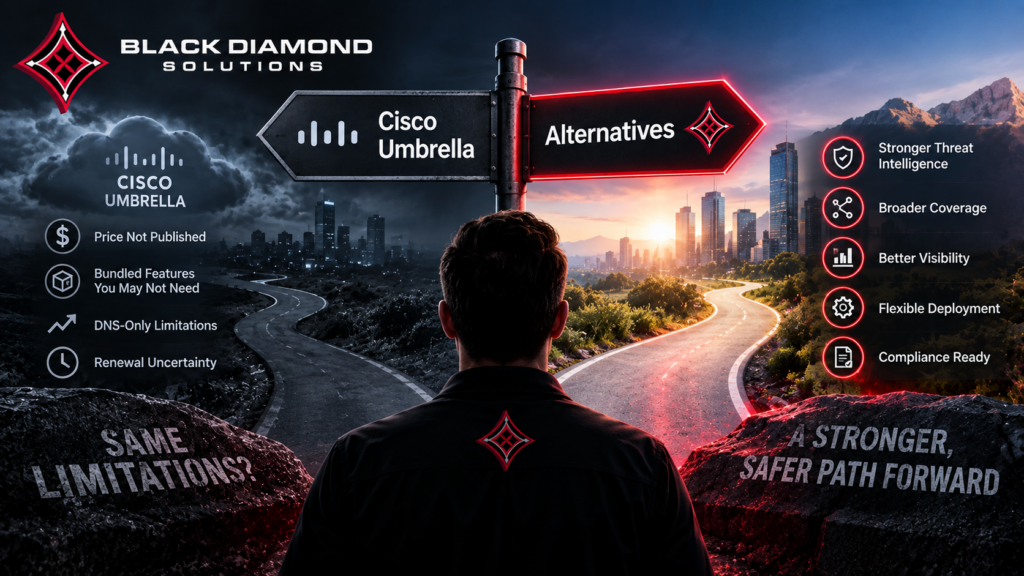
If you searched for “Cisco Umbrella alternatives,” you’re probably staring down a renewal, a budget review, or a coverage gap that Umbrella isn’t closing. You’re not alone. Umbrella is one of the most widely deployed protective DNS platforms on the market, but it’s also one of the most frequently re-evaluated, usually at one of three points: contract renewal, a licensing change that bundles DNS security with products you don’t need, or a security team that has outgrown what DNS filtering alone can do.
In 2026 there’s a fourth reason, and it’s the big one. On September 1, 2026, Cisco Systems published an end-of-sale and end-of-life announcement for Umbrella SIG and DNS as the product evolves into Cisco Secure Access. Every Umbrella customer now has a platform decision to make, and many are using it to shop the category.
This guide is written for IT directors, security leads, and managed service providers at mid-market and regulated organizations (healthcare, education, state and local government, and the defense supply chain) who need to decide what replaces Umbrella before their next renewal. We’ll cover what’s changing with Umbrella, why buyers look for a Cisco Umbrella replacement, what actually separates one protective DNS or threat intelligence platform from another, how the main Cisco Umbrella competitors stack up, and where a threat intelligence gateway like Centripetal CleanINTERNET fits. Black Diamond Solutions (BDS) works with organizations at every stage of this evaluation, from side-by-side comparisons to full migrations, so we’ve built this around the questions we hear most often.
Is Cisco Umbrella Being Discontinued? What the Move to Cisco Secure Access Means
Short answer: yes, as a product name and SKU line. Umbrella isn’t getting switched off overnight, but Cisco has set firm dates. Per Cisco’s end-of-life bulletin (EOL15975), as of November 2026:
| Milestone | Date |
|---|---|
| End-of-life announcement | September 1, 2026 |
| End of sale (last day to order Umbrella DNS or SIG) | January 31, 2027 |
| End of software maintenance releases | January 31, 2027 |
| Last day to renew or change a subscription | January 31, 2028 |
| Last date of support | January 31, 2029 |
Here’s how the packages map over:
- Umbrella DNS Security Essentials and DNS Security Advantage move to Cisco Secure Access DNS Essentials and DNS Advantage, which Cisco markets as Secure Access – DNS Defense.
- Umbrella SIG (secure internet gateway) Essentials and Advantage move to Secure Access SIA (Secure Internet Access), which Cisco describes as an entirely new platform rather than a rename.
- The standalone Umbrella roaming client already reached end of software maintenance on April 2, 2025. Remote users are now protected through the Umbrella module in Cisco Secure Client (the successor to AnyConnect) on Windows, macOS, and mobile devices.
Cisco says it’s providing tools to automate moving your Umbrella configuration and policies over to Secure Access. For a lot of Umbrella customers, that will be the easiest path, and it’s a legitimate one. But it’s still a forced migration: new SKUs, new contracts, and in the case of SIG, a new platform. If you’re going to migrate anyway, it’s the natural moment to ask whether Secure Access, a different DNS filtering vendor, or a different architecture is the best fit for the next five years.
A quick bit of history, since it comes up: Umbrella started as OpenDNS. Cisco acquired OpenDNS in 2015, and the business product went from OpenDNS Umbrella to Cisco Umbrella. Consumer services kept the OpenDNS name.
Why Cisco Umbrella Customers Look for an Alternative
Cisco Umbrella earned its market position honestly. DNS-layer security is a smart, low-friction way to stop a connection to malicious domains before it ever happens, and Umbrella popularized the category. Cisco reports its global network handles traffic for more than 100 million business and consumer users. But a handful of recurring frustrations keep sending Umbrella customers back to the search bar.
Pricing isn’t published, and quotes vary widely. Cisco doesn’t list Umbrella pricing publicly, and per-seat costs are typically negotiated through a reseller based on package tier, contract length, and add-ons. Buyers frequently tell us they can’t get a straight answer on what they’ll actually pay until they’re deep into a sales cycle. Even then, the quote can shift depending on whether they need DNS Security Essentials, DNS Security Advantage, SIG Essentials, SIG Advantage, or a bundle that pulls in Duo, Cisco Secure Client, or Secure Access. For rough context only, a 2026 estimate from dope.security (a direct Umbrella competitor) puts DNS Security Essentials at roughly $30 to $40 per user per year and SIG Advantage at $95 to $135. Treat those as third-party estimates, not Cisco pricing.
The upgrade path pushes you toward tools you may not need. The DNS tiers are DNS-focused, but the moment you need things like full SSL inspection of HTTPS traffic, you’re looking at the SIG tiers, which bundle a secure web gateway (SWG), cloud-delivered firewall, cloud access security broker (CASB), and, in SIG Advantage, data loss prevention and intrusion prevention. Even within the DNS tiers there’s a step: DNS Security Essentials can’t inspect SSL traffic at all, and DNS Security Advantage adds a selective proxy that inspects only risky domains. If your organization mainly needs strong DNS-layer protection plus a bit more, you can end up paying for and managing capability you never asked for.
DNS-only filtering has a ceiling. Protective DNS is excellent at blocking known-bad domains before a connection resolves, but it only sees what happens at the DNS layer. It doesn’t inspect the traffic once a connection is permitted, it doesn’t see direct-to-IP connections that never make DNS requests, and it doesn’t protect the firewall’s own management plane. DNS tunneling, where attackers hide command-and-control (C2) traffic or exfiltrate data inside DNS queries, is a good example of the cat-and-mouse here. Cisco has added AI-based DNS tunneling detection to Umbrella and DNS Defense, and other vendors have their own approaches, so detection quality is worth testing rather than assuming.
Threat intelligence volume varies enormously between vendors, and most buyers never see the number. This is the piece that surprises people most. DNS security tools differ not just in features, but in how much threat intelligence they’re actually enforcing at any given moment, and that number is rarely front and center in a sales conversation. (More on this below.)
Renewal sticker shock. As with most enterprise security suites, multi-year contracts often step up at renewal, which pushes IT directors to formally re-bid the category rather than auto-renew. With Umbrella renewals ending in January 2028, a lot of teams are doing that re-bid now.
None of this makes Umbrella a bad product. Plenty of organizations run it successfully, and some will be happy on Secure Access. It does mean “Cisco Umbrella alternative” is a search a lot of serious, well-informed buyers are making, and the results reflect real switching intent, not idle curiosity.
What to Look for in a Cisco Umbrella Replacement
Before comparing specific products, it helps to have a scorecard. When BDS advises clients on a DNS security or threat intelligence platform switch, we evaluate candidates against six criteria:
- Threat intelligence scale and freshness. How many indicators of compromise (IOCs) does the platform actually enforce, and how often are they refreshed? An IOC is a known-bad signal like a malicious domain, IP address, or URL. A tool that blocks yesterday’s threats is a step behind one enforcing intelligence in near real time.
- Coverage beyond DNS. Does the platform stop at domain resolution, or does it also enforce against IP-based and inline threats, including attacks aimed at your firewall’s own management interface?
- DNS tunneling and exfiltration detection. Can the tool identify malicious traffic hidden inside DNS queries themselves, not just block known phishing sites and malicious domains? Ask for test results, not a feature checkbox.
- Deployment friction. Does it require re-architecting your network, replacing your DNS infrastructure, or installing endpoint agents everywhere? How does it handle remote users and roaming devices, and does it integrate with Active Directory or your identity provider so you can create policies by user or group?
- Transparency. Can you see what’s being blocked in your environment, in near real time, with enough detail to act on? Or do you get a summary report once a month?
- Fit for your compliance posture. If you’re in healthcare, education, government, or a CMMC-regulated defense supply chain, does the vendor understand those requirements? Umbrella, like most cloud DNS services, uses an anycast network that routes each query to the nearest data center, so ask every vendor where queries and logs are processed and stored.
Keep this list nearby. It’s the framework we’ll use to compare Umbrella against the alternatives below.
Quick glossary (because vendor sheets throw these around a lot):
- Protective DNS / DNS filtering: blocks lookups to known phishing URLs, malware, and policy-blocked sites at the DNS level, before a connection is made.
- Secure web gateway (SWG): a proxy that inspects full web traffic, including HTTPS, for URL filtering and malware inspection.
- CASB: discovers and controls cloud apps in use, including unsanctioned shadow IT.
- ZTNA: zero-trust network access, which grants access to private apps based on user identity and device status instead of a VPN.
- Threat intelligence gateway: an inline device or service that enforces large threat indicator lists against all inbound and outbound traffic, not just DNS.
Not Sure Which Tier You Actually Need?
BDS runs a free Threat Intelligence Readiness Assessment that maps your current stack against the six criteria above and scopes the right protective DNS or threat intelligence gateway configuration before you commit to anything.
Get Your Free Assessment | (312) 273-1830 | bds-info@blackdiamondsolutions.com
Cisco Umbrella Competitors: The Landscape at a Glance
“Cisco Umbrella alternatives” is a broad search because the competitive set is genuinely broad. Here are the main Cisco Umbrella competitors, grouped by category, as of November 2026.
Cisco Secure Access (staying with Cisco)
It’s worth listing first, because it’s the default path. Secure Access DNS Defense keeps Umbrella’s DNS-layer features and, per Cisco, adds cloud DLP and malware scanning for cloud file storage apps. If you’re happy with Umbrella and your main goal is minimal disruption, it’s a reasonable choice. The trade-off is that you’re still committing to a new platform and contract, so it’s worth benchmarking against the options below.
DNS filtering and web filtering solutions
DNSFilter, WebTitan, Cloudflare Gateway (part of Cloudflare One), and similar products compete mostly on price, ease of setup, and simplicity. On G2, DNSFilter is currently listed as the best overall Cisco Umbrella alternative, with a rating of about 4.6 out of 5. Cloudflare says its services run across 335+ network locations. These are solid options if your requirement is mainly web filtering, URL filtering, phishing protection, and malicious-domain blocking, and several are cheaper than Umbrella at the low end. Some, like Cloudflare, also offer an upgrade path into a secure web gateway and zero-trust access. If data residency matters to you, ask about it directly; TitanHQ, for example, says WebTitan Cloud is regionalized so your data stays in your region. The trade-off for DNS-only plans is that they stay at the DNS layer, and most enforce a smaller pool of threat indicators than a dedicated threat intelligence platform.
Secure Service Edge (SSE) and SASE platforms
Zscaler, Netskope, Palo Alto Networks Prisma Access, and Cisco’s own full Secure Access suite bundle DNS security into a much larger identity-aware, cloud-delivered architecture that also covers private apps through zero-trust network access (ZTNA). Zscaler, for example, was named a Leader in the 2025 Gartner Magic Quadrant for SSE. These are strong choices for organizations doing a full zero-trust overhaul, especially if you want one platform for web, cloud app, and private app access. They’re also a heavier lift: more expensive, more complex to deploy, and often more than a mid-market IT team needs if the actual goal is simply stronger threat prevention at the edge.
Endpoint and email security vendors extending into DNS
Some endpoint detection and response (EDR) and email security vendors have added DNS filtering as an adjacent feature. These can be convenient if you’re already standardized on that vendor, but DNS protection is rarely their core focus, so test coverage before counting on it.
Threat intelligence gateways
This is a distinct category from protective DNS, and it’s the one most buyers researching Cisco Umbrella alternatives haven’t fully considered yet. A threat intelligence gateway sits inline between your ISP and your firewall and enforces a large, frequently updated set of global threat indicators against all inbound and outbound traffic, not just DNS lookups. Centripetal’s CleanINTERNET platform is the clearest example of this category, and it’s the one BDS deploys most often for clients who have outgrown what protective DNS alone can deliver.
That last category is worth a closer look, because it’s where the biggest difference between Umbrella and the alternatives shows up.
Cisco Umbrella vs. Centripetal CleanINTERNET: The Protective DNS Difference
Centripetal built CleanINTERNET around a specific critique of the protective DNS category: most DNS security tools are constrained by how much threat intelligence they can process and enforce in real time. According to Centripetal, that ceiling sits around 100 million IOCs for a typical DNS-only product. CleanINTERNET, by contrast, enforces 10 billion+ threat indicators sourced from hundreds of open-source, government, and commercial feeds, and checks every DNS request against them in real time. That’s roughly 100 times more, or two orders of magnitude.
One honest caveat: vendors count “indicators” differently. Cisco, for example, says Umbrella has 7+ million malicious domains and IPs actively enforced and discovers 60,000+ new malicious destinations daily, backed by Cisco Talos research. Those numbers aren’t measured the same way as Centripetal’s, so the right move is to ask every vendor on your shortlist the same question: how many indicators do you enforce, from how many sources, and how fast do new ones go live?
Why it matters: DNS filtering is only as good as the list it’s checking against. A domain that hasn’t been catalogued by a smaller intelligence pool won’t get blocked, even if it’s already flagged in a larger one. Centripetal frames its differentiator less as “we have better intelligence” and more as “we have dramatically more of it, curated and enforced automatically.” Their team describes it as having dozens of different vendors’ threat research running in one place at once, instead of being limited to what a single vendor’s research team can produce.
A few other distinctions worth understanding (product details as of November 2026):
Deployment model
CleanINTERNET Enterprise is delivered through a purpose-built appliance called RuleGATE, which sits between your ISP and your firewall: first line of defense on inbound traffic, last line of defense on outbound. Typical installs take under 45 minutes with no impact to live traffic, and BDS manages that installation end to end. CleanINTERNET DNS, the standalone protective DNS service, needs no hardware or endpoint agents; you point your DNS requests at it.
DNS tunneling defense
Centripetal says CleanINTERNET DNS analyzes the full DNS resolution chain to catch tunneling and C2 activity, not just known-bad domain names. Its bigger architectural point is that it pairs DNS-layer protection with RuleGATE’s inline enforcement on all traffic, so an exfiltration attempt that doesn’t rely on DNS still has to get past the gateway. If tunneling is a specific concern for you, test it during a proof of value alongside whatever you’re evaluating from Cisco or anyone else.
Protecting the firewall itself
Most tools in this category focus on what happens behind the firewall. Centripetal also enforces against threats aimed at the firewall’s own management plane and SSL VPN interfaces, which matters given how often management-plane vulnerabilities in firewall platforms have made headlines in recent years. Centripetal also points to shadow IT discovery as a side benefit: a new RuleGATE install can surface an exposed service or forgotten system soon after monitoring starts, simply because full traffic visibility shows what was never supposed to be internet-facing.
Latency
Because RuleGATE filters at wire speed, Centripetal reports under 50 microseconds of latency. For perspective, that’s 0.05 milliseconds, so end users won’t notice it.
Transparency
Whatever you choose, ask to see the reporting before you buy. Centripetal provides dashboards and reporting that show inbound and outbound threats being blocked and monitored across your environment, backed by its Intelligence Operations team of analysts who monitor emerging threats and update enforcement as indicators change.
Not a rip-and-replace
It’s worth being direct about scope: CleanINTERNET doesn’t replace your firewall, EDR, or intrusion prevention system, and BDS doesn’t position it that way. The one place Centripetal does position it as a direct replacement is protective DNS, versus Cisco Umbrella and OpenDNS-style products. Everywhere else in your stack, the framing is complement and offload: reducing the volume of traffic your firewall and SIEM (such as Splunk or Microsoft Sentinel) have to process, not eliminating the tools around them.
See the Coverage Gap in Your Own Environment
Centripetal offers 30-day Proof of Value trials, so you can see real results in your network, not a vendor demo, before deciding whether CleanINTERNET is the right Cisco Umbrella replacement for you.
Start a 30-Day Proof of Value | (312) 273-1830 | bds-info@blackdiamondsolutions.com
Threat Intelligence Gateways vs. Protective DNS: Do You Need Both?
Not every organization needs the full RuleGATE deployment. Centripetal’s own team uses a good analogy here: putting a full inline threat intelligence gateway in front of an organization with no public-facing services and minimal external attack surface is “like driving a Ferrari to the supermarket.” A car dealership with a small back-office network, for example, may only need CleanINTERNET DNS rather than the full gateway.
That’s a useful way to qualify whether you need a “Cisco Umbrella DNS alternative” or a broader threat intelligence gateway:
- If your main exposure is web browsing and everyday phishing and malicious-domain risk, a strong standalone protective DNS product, including CleanINTERNET DNS, may be all you need. It’s a lighter, lower-cost entry point.
- If you run public-facing services, have remote or hybrid staff, handle sensitive data, or have compliance obligations around threat prevention (not just detection), the case for a full threat intelligence gateway gets stronger, because DNS-only protection can’t see or stop everything moving in and out of your network.
- If DNS tunneling, C2 activity, or data exfiltration are specific concerns (common in regulated industries and for any organization that’s been breached before), you want inline enforcement and DNS-layer protection working together, not one or the other.
This is also where what Centripetal calls the “80/19/1” pattern is worth understanding. Based on the breaches Centripetal says it has studied, roughly 80% happened because the organization never had the relevant threat intelligence in the first place. Often that’s a lock-in problem: you get one manufacturer’s threat research when you buy their firewall, but not another vendor’s, even if that vendor flagged the exact indicator days earlier. About 19% happened because the organization had the intelligence somewhere in its stack but didn’t act on it in time. By the time an analyst is searching logs for an indicator of compromise, the incident has usually already happened; that’s forensics, not prevention. The remaining roughly 1% came down to alert fatigue: the signal existed, but it was buried in noise. A platform that enforces a large volume of curated threat intelligence automatically, before traffic reaches your firewall or SIEM, is built to address the first two causes directly, and by cutting the volume of alerts reaching your SIEM, it helps with the third.
Migrating From Cisco Umbrella: What the Process Looks Like
If you’ve made it this far, the migration itself can feel like the biggest barrier. Whether you’re moving to Secure Access or somewhere else, Umbrella’s end-of-life timeline means a migration is coming either way. Moving off Umbrella onto a threat intelligence gateway follows a fairly predictable path:
- Assessment. BDS reviews your current DNS security configuration, firewall architecture, Umbrella renewal dates, and compliance requirements to scope the right deployment: DNS-only, full gateway, or a phased rollout of both.
- Parallel run. Most migrations start with a proof-of-value period rather than a hard cutover. Centripetal offers 30-day Proof of Value trials, so you see real results in your own environment before committing.
- RuleGATE installation. If a full gateway deployment is the right fit, the appliance installs at your network edge, typically in under 45 minutes with no disruption to live traffic.
- Policy tuning and cutover. BDS and Centripetal’s Intelligence Operations team configure policy alongside your existing DNS infrastructure, so there’s no need to rip out what you already run.
- Decommission and renewal management. Once you’re confident in the new platform, BDS manages the Umbrella contract wind-down timeline so you’re not paying for two DNS security tools at once.
Because BDS handles licensing, deployment scheduling, and renewal tracking as part of every Centripetal engagement, most clients have a single account manager from quote through renewal instead of juggling multiple vendor contacts and support teams during the switch.
Frequently Asked Questions
Is Cisco Umbrella being discontinued?
Cisco has announced end of sale and end of life for Umbrella SIG and DNS. Per Cisco’s bulletin, the last day to order is January 31, 2027, the last day to renew is January 31, 2028, and support ends January 31, 2029. Existing subscriptions keep working until their terms end.
What is Cisco Umbrella being replaced with?
Cisco Secure Access. Umbrella DNS packages map to Secure Access DNS Essentials and DNS Advantage (marketed as DNS Defense), and Umbrella SIG maps to Secure Access SIA. You can follow Cisco’s migration path or treat the change as a chance to evaluate other platforms.
Who are the main Cisco Umbrella competitors?
They fall into a few groups: DNS and web filtering tools like DNSFilter, WebTitan, and Cloudflare Gateway; SSE and SASE platforms like Zscaler, Netskope, and Palo Alto Networks Prisma Access; and threat intelligence gateways like Centripetal CleanINTERNET. Cisco Secure Access is also a contender if you want to stay with Cisco.
What is the best Cisco Umbrella alternative?
It depends on what you’re replacing Umbrella for. If you want a lighter DNS filtering tool at a lower price point, DNSFilter or Cloudflare Gateway are worth evaluating. If you want a big step up in threat intelligence scale plus coverage beyond the DNS layer, including firewall management-plane protection and inline enforcement against DNS tunneling and exfiltration, Centripetal CleanINTERNET is built as a like-for-like replacement for Umbrella’s protective DNS use case that also covers ground DNS-only tools don’t.
What does DNS filtering do?
DNS filtering checks each domain lookup your users and devices make against lists of known-malicious and policy-blocked sites. If a domain is flagged, the DNS request is blocked before a connection is ever made, which stops a lot of phishing, malware, and unwanted content early and cheaply.
Is there a free or low-cost Cisco Umbrella replacement?
Several DNS filtering tools offer free or low-cost tiers aimed at small environments or personal use, and public resolvers like Google Public DNS are free but aren’t built for business policy control. These can be fine for basic content filtering, but they typically enforce a much smaller threat intelligence dataset and won’t cover inline enforcement or firewall-facing protection. For a business network with sensitive data or compliance requirements, a free tier is rarely a like-for-like substitute.
How is a threat intelligence gateway different from protective DNS?
Protective DNS only evaluates domain name lookups. It can block a connection to a known-bad domain before it resolves, but it doesn’t inspect traffic once a connection is permitted. A threat intelligence gateway like CleanINTERNET Enterprise sits inline at the network edge and enforces threat intelligence against all inbound and outbound traffic, which closes gaps like direct-to-IP connections and attacks aimed at the firewall itself.
Will replacing Cisco Umbrella require a full network redesign?
Not typically. CleanINTERNET deploys at the network edge between your ISP and firewall without replacing your existing DNS infrastructure or requiring endpoint agents on every device. BDS manages installation, and typical RuleGATE installs take under 45 minutes with no live traffic impact.
Can I try an alternative before fully committing?
Yes. BDS and Centripetal offer 30-day Proof of Value engagements in your own environment, before you buy or let an Umbrella renewal lapse.
Is Centripetal CleanINTERNET suitable for regulated industries?
Centripetal’s customer base includes healthcare, higher education, K-12, state and local government, and CMMC-regulated defense-adjacent organizations. These are environments where BDS often sees high threat exposure combined with small IT teams, which is exactly where automated, real-time threat prevention pays off. BDS scopes the right configuration for your specific compliance framework during the initial assessment.
Where BDS Fits In
Switching a core piece of your security stack isn’t a decision to make from a spec sheet alone, and Umbrella’s end-of-life dates mean the clock is already running. As a Platinum Centripetal partner, Black Diamond Solutions handles the full lifecycle of a CleanINTERNET deployment: assessment, RuleGATE installation, policy configuration, and ongoing renewal and licensing management, with a single account manager from first conversation through renewal. If you’re weighing Cisco Umbrella alternatives and want a clear-eyed comparison for your environment, let’s talk.
Ready to Replace Cisco Umbrella With Real-Time Threat Prevention?
Black Diamond Solutions is a Platinum Centripetal partner. Talk to a BDS specialist about deploying CleanINTERNET in your environment: real-time threat prevention, backed by a dedicated account manager from quote through renewal.
Schedule Your Free Assessment | Contact BDS
Black Diamond Solutions | (312) 273-1830 | bds-info@blackdiamondsolutions.com
Recent Posts
What Is a Threat Intelligence Gateway (TIG)?
November 12, 2026
Standalone PHASR: How to Add Attack Surface Reduction to Any EDR Stack
September 19, 2026