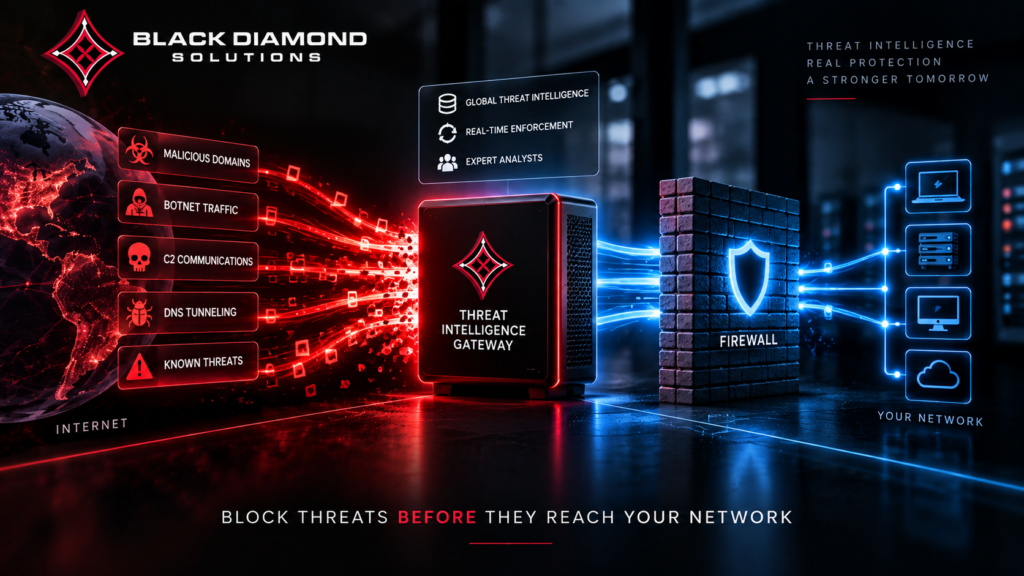
What Is a Threat Intelligence Gateway (TIG)?
If you’ve spent any time researching how to cut down on firewall load, close DNS tunneling gaps, or stop threats before they generate a SIEM alert, you’ve likely run into the term “threat intelligence gateway.” It’s a newer category name for an older idea, run at a scale most security stacks weren’t built for: what if your network could automatically block a known-bad connection before it ever reached your firewall, using threat intelligence far broader than any single vendor’s research team could produce?
That idea sits at the center of what Gartner now calls preemptive cybersecurity: stopping cyber attacks before they land instead of detecting and cleaning up after them. A threat intelligence gateway is one of the most practical ways to put that into place today.
This guide is for IT directors, security leads and network teams at mid-sized and enterprise organizations, especially teams that are drowning in alerts and don’t have a 24/7 security operations center. Here’s what a Threat Intelligence Gateway (TIG) actually is, how it works, how it compares to a firewall, a Threat Intelligence Platform (TIP) and an IPS, and where it fits in a preemptive security strategy.
What Is a Threat Intelligence Gateway? The Short Definition
A Threat Intelligence Gateway (TIG) is a network security appliance or service that sits inline, typically between your internet connection and your firewall, and automatically blocks traffic matching known malicious indicators in real time, before that traffic reaches the rest of your security stack.
In practice, a TIG connects external threat data to your security systems. It gathers threat intelligence from many industry sources, often exchanged in standard formats like STIX and TAXII, then normalizes and deduplicates those indicators before they reach your controls. The core indicators it blocks are malicious IP addresses, domains and URLs. Because the gateway automates updates to that blocklist, your team doesn’t have to load feeds or write rules by hand, which cuts out most of the manual effort of handling threat data. Many TIGs also log what they block, which you can feed into your SIEM to enrich alerts with threat context.
An Additional Measure, Not a Replacement
A TIG works as a pre-filter that makes a traditional firewall’s job easier. It is not a replacement for a next-generation firewall (NGFW) or an intrusion prevention system (IPS). It sits in front of them and takes the known-bad traffic off their plate.
A Threat Intelligence Platform aggregates and analyzes threat data for human analysts. A firewall enforces a relatively small, manually maintained rule set. A TIG is built to do one thing at massive scale: take a huge, continuously updated pool of cyber threat intelligence (malicious IP addresses, domains, URLs and other indicators of compromise, or IOCs) and enforce it automatically against every packet crossing your network perimeter. Nothing waits for an analyst to act. The block happens at wire speed, before the connection is established.
This matters because most security tools operate downstream of the threat. A firewall enforces the policy you configure. A SIEM correlates logs after they’re generated. An EDR platform or an MDR service responds to something that has already touched an endpoint. A TIG works further upstream than all of them, filtering out known threats before they ever create the alert, the log entry or the security incident in the first place.
How Does a Threat Intelligence Gateway Work? The Key Components
A TIG comes down to three layers working together.
1. Intelligence aggregation. A TIG platform continuously ingests threat intelligence data from a wide range of sources: open source intelligence (OSINT) feeds, government intelligence, commercial threat research and proprietary detection. Much of this threat intelligence sharing happens in standard formats like STIX and TAXII. The gateway normalizes and deduplicates all of that raw data into one usable indicator set. The difference between TIG vendors comes down mostly to scale and curation: how many sources are tracked, how many indicators get processed, and how fast a newly identified threat reaches the enforcement layer.
2. Real-time enforcement. Once the intelligence is validated, it’s pushed to the enforcement appliance at your network edge. That appliance checks inbound and outbound traffic against the current indicator set and drops anything that matches. No human reviews each match, and legitimate traffic isn’t slowed down in any way you’d notice. Checking outbound traffic matters as much as inbound: unusual outbound network traffic to a known command-and-control server is often the first sign of an infected device, and a TIG can cut that connection before data leaves. Centripetal, for example, says its RuleGATE filters with “undetectable latency”, and an ESG technical validation describes it processing packets at line rates up to 100 Gb/s.
3. Human oversight and tuning. Automated enforcement doesn’t mean unsupervised. Mature TIG deployments include an intelligence operations layer: security analysts who track the global threat landscape and emerging threats, tune detection logic, and investigate edge cases the automated layer flags but doesn’t act on alone. Many platforms also use machine learning and artificial intelligence to score how severe each event is. This is what separates a mature TIG from a simple blocklist. The intelligence is a living, actively managed asset, not a static file.
Put together, a TIG works as a high-volume filter in front of everything else you own. It doesn’t replace your firewall, your SIEM or your endpoint tools. It cuts down how much traffic reaches them, so those tools and your security teams can spend their attention on genuine threats that actually need a decision.
See What’s Actually Reaching Your Firewall
BDS can set up a 30-day Proof of Value with Centripetal CleanINTERNET on your own network, so you see exactly what a threat intelligence gateway blocks before you commit to anything.
Start a 30-Day Proof of Value | (312) 273-1830 | bds-info@blackdiamondsolutions.com
Where a Threat Intelligence Gateway Fits in Preemptive Cybersecurity
“Preemptive cybersecurity” is the label Gartner uses for the shift from reacting to attacks toward stopping them before they happen. It’s a proactive approach: instead of waiting for an alert, you remove potential threats before they reach anything you own. Gartner named it one of its Top Strategic Technology Trends for 2026, and in a September 2025 press release it predicted that preemptive cybersecurity technologies will account for more than 50% of IT security spending by 2030, up from less than 5% in 2024.
The reason is simple math. Gartner expects documented vulnerabilities (CVEs) to grow from about 277,000 in 2025 to more than 1 million by 2030. Reactive models, where you detect an intrusion and then respond, can’t keep up when the attack surface grows that fast, emerging threats appear daily, and threat actors use AI to move quicker.
Gartner frames preemptive cyber defense around three ideas: deny, deceive and disrupt attackers before they reach their goal. A threat intelligence gateway is the “deny” piece in its purest form. It takes what the security community already knows about malicious activity and refuses those connections at the edge, automatically, before your firewall or anyone on your team has to deal with them.
What a TIG Covers, and What It Doesn’t
A TIG doesn’t cover the whole preemptive defense model on its own. Deception tools, attack surface management and continuous exposure testing handle other parts of the job. But for most organizations, blocking known-bad traffic upstream is the fastest preemptive measure to deploy and the easiest to prove, because you can count what it blocked.
Threat Intelligence Gateway vs. Firewall
This is the comparison most people researching TIGs want answered first, because on paper the two sound alike: both sit at the network edge and both block traffic.
The difference is in what drives the blocking decision and how much intelligence each tool can realistically enforce.
A firewall enforces rules you configure: IP allow and deny lists, port and protocol policy, and, in next-generation firewalls, some signature-based threat detection. That threat detection usually runs on whatever intelligence that specific vendor produces or licenses. And a firewall is already busy with routing, VPN termination and deep packet inspection, so there’s a hard limit on how many indicators it can check at line rate. Centripetal puts it bluntly: firewalls can handle less than 1% of the high-fidelity threat intelligence available today.
A threat intelligence gateway is purpose-built to enforce threat intelligence at a scale and speed a NGFW wasn’t designed for. A well-built TIG enforces billions of indicators from many intelligence sources, updated continuously, without becoming the network bottleneck.
Sitting in front of the firewall also helps protect the firewall itself. Firewalls, VPN gateways and other edge devices are a favorite target for attackers. In 2025, CISA and partner agencies released guidance specifically on protecting them, including analysis of real-world edge device compromises. A TIG can’t patch your firewall, but it can drop traffic from known-malicious sources before it ever reaches the firewall’s exposed interfaces.
In practice, organizations don’t choose one over the other. A TIG goes in as a layer in front of the firewall, not as a replacement. It cuts down the volume of what reaches the firewall so the firewall can do its job well.
Threat Intelligence Gateway vs. Threat Intelligence Platform (TIP)
The similarity in names is confusing, but they solve different problems.
A Threat Intelligence Platform (TIP) is primarily an aggregation and analysis tool. It pulls in threat data from multiple sources, normalizes it, lets analysts investigate and correlate indicators, and supports analyst workflows and case management. It typically exports curated intelligence to other tools, like a SIEM, a firewall or an EDR platform, for enforcement elsewhere. A TIP is built for the human side of threat intelligence: research, context, prioritization and distribution.
A Threat Intelligence Gateway (TIG) is built for the enforcement side. It doesn’t just organize threat intelligence for someone else to act on; it acts on it directly, automatically and inline, at network speed. Some TIG platforms include TIP-like features, such as a portal showing what’s being blocked and why, or logs that help with enriching alerts in your SIEM. But the core job is different: a TIP informs decisions, and a TIG makes and enforces them in real time.
Organizations with a mature security operations center sometimes run both: a TIP for analyst-driven investigation and cross-tool intelligence sharing, and a TIG for automated, high-volume enforcement at the perimeter. For organizations without the staff to run a full TIP program, a TIG delivers the enforcement value without needing a team of analysts to operate it.
Threat Intelligence Gateway vs. IPS
Intrusion prevention systems (IPS) and TIGs both sit inline and both block traffic automatically. That makes this the closest comparison of the three, and the one with the most overlap.
The core difference is what each tool looks for. A traditional IPS is built around signature-based detection and behavioral or anomaly analysis. It inspects traffic patterns for known attack signatures or statistically unusual behavior, and it’s very good at catching exploitation attempts in progress. That inspection takes a lot of processing, so an always-on IPS engine can add latency under heavy load. Without careful tuning, it can also throw a high rate of false positives that create their own alert fatigue.
A TIG is built around indicator-based enforcement: matching traffic against a known-malicious dataset instead of analyzing behavior. That makes it much faster, since checking an indicator list is computationally lighter than deep behavioral inspection. It’s also more targeted. It stops connections to known-bad infrastructure, not brand-new attack patterns nobody has intelligence on yet.
Some TIG platforms combine the two ideas. They add a secondary, IPS-like inspection layer that only kicks in when a connection has already matched a threat indicator, saving deep packet inspection for traffic that’s already suspicious instead of running it against everything. That hybrid approach gets much of the value of IPS-style inspection without the always-on performance cost, because the expensive analysis only runs on a small, pre-filtered slice of total traffic.
Why Organizations Are Adopting Threat Intelligence Gateways for Network Security
The category exists because of a pattern security teams keep running into after a breach: some intelligence about the threat usually existed somewhere before the incident. The organization just didn’t have it, didn’t act on it in time, or the signal was buried in noise.
That pattern tends to break down three ways:
- An intelligence gap. The organization never had the specific indicator that would have flagged the threat. Threat intelligence is often siloed by vendor. When you buy one manufacturer’s firewall, you get its research, not a competitor’s. Often times a competitor flagged the exact indicator days earlier.
- A timing gap. The intelligence existed somewhere in the stack, but by the time an analyst found it, the breach had already happened. That’s forensic investigation, not prevention.
- Alert fatigue. The signal was there, but it got lost in the volume.
A TIG closes the first two gaps directly. It pulls threat intelligence from many providers instead of one, and it enforces it automatically instead of waiting for a person to act. By filtering out known threats before they create downstream alerts, it also eases the third problem as a side effect. Fewer, more meaningful alerts reach an already-stretched security team, and the organization’s security posture improves without adding headcount. That’s the practical case for a TIG: it strengthens your cybersecurity defenses at the network perimeter without asking a small team to do more.
Centripetal CleanINTERNET: A Threat Intelligence Gateway in Practice
Black Diamond Solutions (BDS) is a Platinum partner for Centripetal, whose CleanINTERNET service is one of the clearest real-world examples of the TIG category.
Centripetal itself describes its RuleGATE appliance as providing TIG functionality, backed by its own Intelligence Operations Analysts. The RuleGATE sits between your ISP and your firewall as a first line of defense for both inbound and outbound traffic.
CleanINTERNET vs. DNS-Only Filtering
A lot of organizations already run DNS filtering and ask how a full gateway is different. Here’s the short version, based on our Centripetal partner page and Centripetal’s FAQ, as of November 2026:
| CleanINTERNET (RuleGATE) | Typical DNS-only filtering | |
|---|---|---|
| Threat indicators enforced | 10 billion+ | Around 100 million |
| What it checks | Every packet, inbound and outbound | DNS lookups only |
| Where it sits | Inline between your ISP and firewall | At the DNS resolver |
| Hardware | RuleGATE appliance (physical or virtual) | Usually none |
| Human oversight | Centripetal Intelligence Operations Analysts | Varies by vendor |
DNS filtering is still a solid first step, and Centripetal offers its own CleanINTERNET DNS tier. It just can’t see traffic that never makes a DNS request, like connections straight to a malicious IP address.
What Centripetal Reports
Here’s what Centripetal reports on its solutions page and FAQ, as of November 2026:
- Scale of intelligence. CleanINTERNET enforces more than 10 billion indicators of compromise, drawn from thousands of open source, government and commercial feeds. That’s more than 100x what DNS-only tools typically enforce.
- Results downstream. Centripetal says the service stops 99% of known threats before they reach your firewall, network or SIEM, and that downstream SIEM events drop by up to 90%. One senior cybersecurity architect at a large healthcare system described going from about 60 million events to about 500,000 after deployment.
- Deployment is fast. RuleGATE typically installs at the network edge in under 45 minutes, mostly the time to rack, power and cable it, with no impact on live traffic.
- It doesn’t replace your existing stack. CleanINTERNET complements your firewall, SIEM and EDR tools by cutting the volume they process. It doesn’t eliminate any of them.
- Visibility isn’t a black box. Customers get a CleanINTERNET portal with threat-blocking data, traffic insights and visibility into policy enforcement, plus detailed logs for forensics and audits.
- Sensitive data stays put. Centripetal says the service works from publicly visible addressing information and doesn’t extract personally identifiable information. Packet capture content stays inside your network unless you consent.
- Options beyond the edge. CleanINTERNET DNS offers a lighter, hardware-free starting point. Also, supplying versions for remote users and cloud environments on AWS and Azure.
See a Threat Intelligence Gateway on Your Own Traffic
BDS and Centripetal run a 30-day Proof of Value on your network. At the end, you get a readout of what it actually blocked, not a vendor demo.
Start a 30-Day Proof of Value | (312) 273-1830 | bds-info@blackdiamondsolutions.com
Frequently Asked Questions
What is a threat intelligence gateway in simple terms?
It’s a device or service at your network edge that automatically blocks traffic to and from known-malicious IP addresses, domains and infrastructure. It uses a much larger and more frequently updated set of threat intelligence than a typical firewall can enforce on its own.
What does TIG stand for in cybersecurity?
TIG stands for Threat Intelligence Gateway: a network security layer that enforces aggregated, real-time threat intelligence inline, automatically blocking known threats before they reach the rest of a security stack.
What is preemptive cybersecurity?
Preemptive cybersecurity is an approach that stops attacks before they happen instead of detecting and responding after the fact. Gartner describes it as using AI-powered security operations, programmatic denial and deception to act before attackers strike. A threat intelligence gateway is one of the most direct preemptive security solutions, because it denies known-bad connections automatically at the edge.
How does a threat intelligence gateway work?
A TIG continuously ingests threat intelligence from many sources, validates and deduplicates it, and enforces it against all inbound and outbound traffic where it enters or leaves your network, typically before that traffic reaches your firewall. Matches are blocked automatically and in real time, while an intelligence operations team monitors results and tunes detection logic.
What is the difference between a firewall and a gateway?
A firewall enforces the security policy you configure: what ports, protocols and addresses are allowed. A threat intelligence gateway enforces outside intelligence about what’s known to be malicious. A firewall typically carries threat intelligence from one vendor’s research, while a TIG enforces a far larger, multi-source dataset and is usually deployed in front of the firewall, not in place of it.
Do I need a threat intelligence gateway if I already have an IPS?
It depends on your risk profile. An IPS is strong at catching in-progress exploitation attempts through signature and behavioral analysis. A TIG is built for fast, high-volume blocking of known-malicious traffic before it gets that far. Organizations with significant external exposure, regulated data or a history of alert fatigue often run both, since each covers a different part of the threat lifecycle.
What is a threat intelligence feed, and how is it different from a TIG?
A threat intelligence feed is just data: a stream of indicators that someone still has to load into a tool and act on. A TIG is the enforcement layer itself. It ingests feeds from many sources and automatically blocks matching traffic in real time, relieving the need for manual updates.
Is a threat intelligence gateway worth it for a mid-sized business?
For organizations with public-facing services, remote or hybrid staff, or compliance requirements around active threat prevention, a TIG can meaningfully reduce risk and downstream alert volume without adding headcount. For smaller environments with little external exposure, a lighter option like protective DNS filtering may be a better first step than a full gateway.
Talk to BDS About Deploying a Threat Intelligence Gateway
Understanding the category is the easy part. Scoping the right deployment for your environment is where BDS comes in. As a Platinum Centripetal partner, we handle the full lifecycle of a CleanINTERNET deployment, from the 30-day Proof of Value through RuleGATE installation, policy configuration and ongoing renewals, with a single account manager coordinating the whole process.
Ready to Stop Threats Before They Reach Your Network?
Talk to a BDS specialist about running a 30-day Proof of Value with Centripetal CleanINTERNET, a real-world threat intelligence gateway, on your own network.
Start Your 30-Day Proof of Value
Black Diamond Solutions | (312) 273-1830 | bds-info@blackdiamondsolutions.com
blackdiamondsolutions.com | Centripetal Partner Page | Contact BDS
Recent Posts


Standalone PHASR: How to Add Attack Surface Reduction to Any EDR Stack
September 19, 2026